Simpoiesis
sim-poy-EE-sis. From the Greek sún, “with”, and poiesis, “making”
Making-with. The idea that nothing is made alone: lives, work and communities are made together, in relationship with other people, places and the living world.
A term used by M. Beth Dempster in 1998 and taken up by Donna Haraway.
Life takes shape in relationship
Lives take shape in our relationships with each other, with place and with the world around us. I pay attention to the whole person and to what surrounds them: family, housing, work, money, culture, Country.
That makes this work more like tending a garden than building a bridge. Care, trust and belonging emerge from relationships, conditions and time. No leader can guarantee them, but a leader can set the conditions and notice when the system is crowding them out.
How the ideas fit together
- Simpoiesis is the why. Life is made together, in relationship.
- The Paperbark is how I see a person. Layers, held inside family, community and the wider system.
- The Murmuration is how groups move. No one leads, and everyone shapes it.
- Communities of Care are what a community builds. Its own way of caring, grown from the inside.
What this changes in practice
- A team keeps losing good people. Instead of more resilience training, I look at workload, rules and support, and ask the team what would help.
- Someone has to tell their story to a fourth service. I map who they deal with and what each one asks of them, then work out what can change, starting with what is within reach.
- A community wants a program. I start with who is already caring for people, and what the community wants to keep, change or build.
- A worker brings a hard case to supervision. I look at their practice, and at the conditions they are practising in.
How I work
- Listen. Start with what people already know and already do.
- Look at the conditions. Rules, workload, funding and who decides.
- Try something small. A step within reach that is safe to get wrong, not a big program.
- Notice what grows. Keep what works, let go of what does not, and let the next step come from that.
What we watch for
Not targets handed down, but signs that care is taking root:
- Decisions made closer to home, by the people who live with them.
- Fewer retellings. People do not have to tell their story again and again.
- Workers who stay and feel safe to speak up.
- Rules that change where they can.
The Paperbark
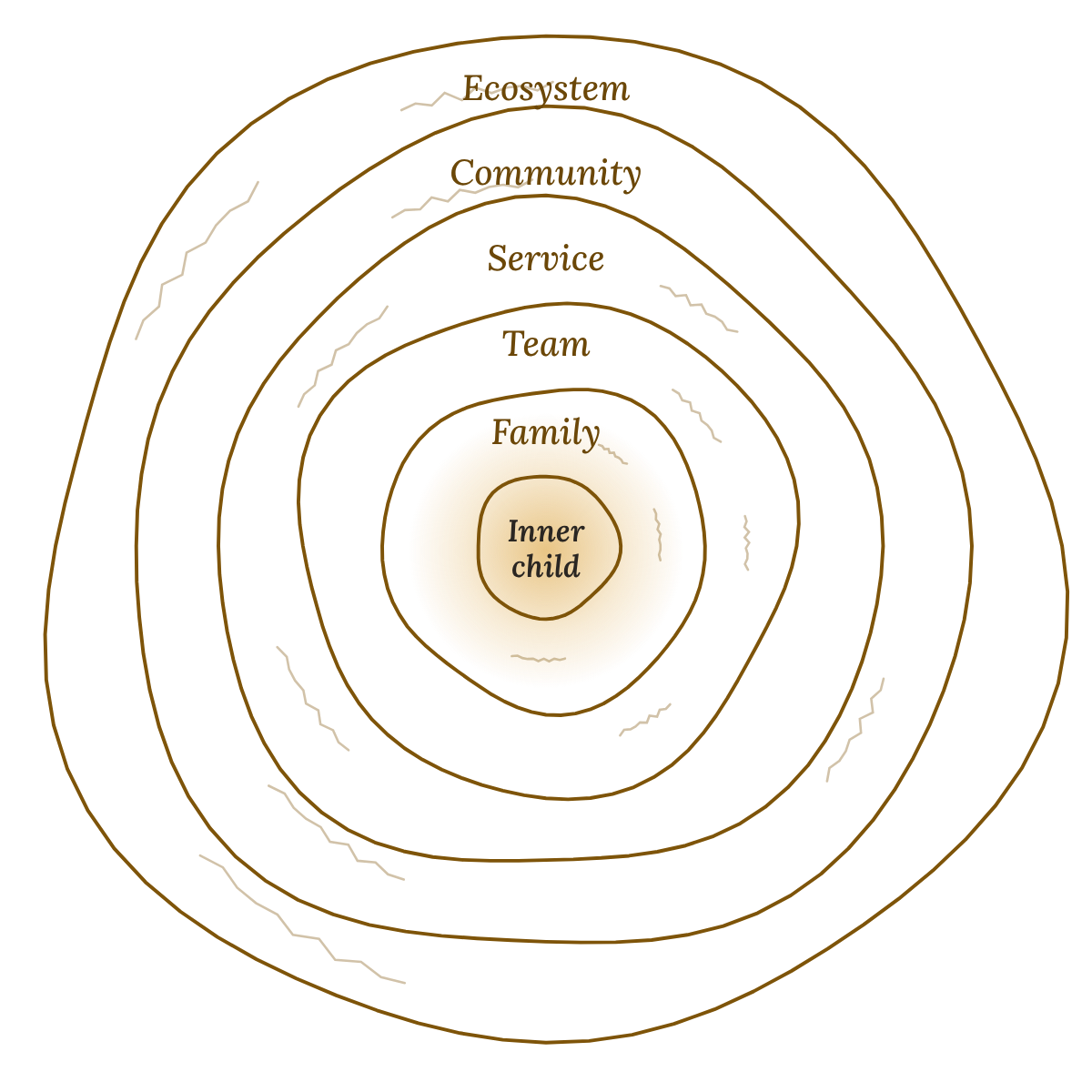
Inside each of us are layers, like a paperbark tree, with the inner child at the centre.
Paperbark grows in thin layers. Each one protects what lies beneath, and the tree can grow again after fire.
Where pain has frozen part of us, that part moves into survival. The habit carries on unconsciously, trying to keep us safe. The stuck part cannot see that change is possible.
Change begins with safety we can feel in the body. When the nervous system settles, we can choose a different course. Here we become our own teacher and student at the same time.
Our actions come from beliefs and thoughts. Tracing the pain back is one way to understand why we respond as we do, knowing there are many threads:
- Nature and nurture
- Attachment
- Intergenerational trauma
- Lateral violence
- Systems
- Self-organising chaos
- Strengths-based practice
- Narrative practice
- Holistic health
- The soul
The layers stand for the whole ecosystem: the inner child, held inside a family, a team, a service, a community and the wider system. The pattern repeats at every layer. So does the way out: safety first, then choice.
What is happening in survival mode
When the body senses danger, the alarm goes off before the thinking part of the brain has a say. Stress hormones rush through us, the heart speeds up and the muscles get ready. The part at the front of the brain that plans and chooses (the frontal lobe) quietens. That is not weakness. It is the body putting safety first.
The alarm is set by what we have lived through, so it can go off in safe moments too, when something feels like old danger. The reaction is automatic, not a decision.
Fight
Anger, arguing, defending, pushing back.
Flight
Leaving, avoiding, staying busy, getting away.
Freeze
Going blank, shutting down, unable to speak or move.
Fawn
Pleasing, agreeing, keeping the peace to stay safe.
Coming back. Slow breathing, feet on the ground and a steady person beside us tell the body it is safe. As the body settles, the thinking part comes back online, and with it, choice. This is co-regulation: one calm nervous system helping another.
A simple picture of a complex process, not a diagnosis. Fight or flight comes from Walter Cannon’s work a century ago. Freeze was added later, and fawn comes from therapist Pete Walker’s writing on complex trauma.
The whole person, not compartments
Mental health care often separates a person into parts and works on the symptom or the risk behaviour. I stay with the whole person, and with what sits underneath the behaviour, which in my experience so often traces back to some form of trauma. From there we can integrate and reframe. Once we are aware that there is a choice, we can choose differently.
The professional and the personal are not separate. Under pressure, they show up together.
The Paperbark is my own way of seeing, built from long practice and learning. It is a way of seeing, not a diagnosis, and it shapes my supervision and counselling.
The Murmuration
Budgerigars follow the rain across inland Australia, including the Northern Territory. After good rain they gather in their thousands and turn as one shape, with no bird in charge.
Studies of flocking birds have found that each bird tracks about seven neighbours, not the whole flock. Nobody directs the pattern. It emerges from many small interactions, just as it does in a healthy team or community. I call it Murmuration energy: people close enough to move together, and free enough to respond.
Connect
Stay close enough to feel what is moving, with strong ties to the people near you and ways for news to travel.
Diversity
Different people notice different things. A system that hears only one kind of voice cannot see what it is missing.
Interaction
Patterns come from how people meet, not from instructions at the top. Change who talks to whom, and the shape changes.
Adapt
When something shifts, the whole moves with it. Teams and communities that respond locally learn fast.
No bird leads the Murmuration. Every bird shapes it.
Flocking research: Ballerini and colleagues, 2008 (starlings).