Ways to work together
Start small. Begin with a conversation, a listening session or a single supervision session. See what grows, then decide what comes next.
Communities and organisations
People know their own lives and places. I work alongside you: listening sessions in your own time, a shared look at what helps and what gets in the way, and planning with the people who will carry the work. You leave with a plan that belongs to you.
Where In person in community when invited, and online or by phone in between.
Who Community groups, Aboriginal community-controlled organisations, services and local leaders.
How long From a single conversation to an ongoing relationship, agreed together.
Supervision
Professional supervision for social workers, community workers and teams in community, health and human services. A place to think through hard cases, and to look at your practice, the conditions you practise in and what needs to change. Under pressure the personal and the professional arrive together, so supervision holds both. Confidential, within the limits of safety and the law.
Where Online or by phone anywhere in Australia, and in person in Darwin or when visiting.
Who Individual workers, and teams or groups.
How long A single session or regular sessions over time, agreed together.
Counselling
Co-regulation conversations
Not the traditional kind. A conversation, not an interview, at a pace that is yours. We name what is happening, notice what your body is doing and try small things that fit your life. Two nervous systems settling together, so there is room to choose.
It draws on narrative practice and strengths-based work: coming back round, gently and in your own time, to what has been hard.
You are not the problem. The problem is the problem. Confidential, within the limits of safety and the law.
“Lynda is deeply intuitive and perceptive. She follows the hidden and unspoken threads and helps you understand what is happening deep within. She names what feels just out of reach and helps you see how much power and choice you really have. She has helped me find my strength and deepen my trust in myself at times when I have felt so lost.”
Where Online or by phone anywhere in Australia, and in person in Darwin or when visiting.
How long A single conversation or regular sessions over time, agreed together.
Not a crisis service. If you or someone else is in danger, call 000. For support any time, call Lifeline on 13 11 14.
Groups and gatherings
For women, by invitation, with room for different beliefs. A few hours, a day or a series in a small group, with conversation, story, rest and ceremony of the everyday kind. Access and cost are talked through at the start, with follow-up afterwards.
Where In person, in a place that suits the women involved.
Who Women, as a group or as an individual enquiring.
How to start One woman or a group can ask.
Speaking
Talks and conversations about belonging, care and power, and how everyday practice connects with the conditions people live and work in.
- The Fourth Service. What it costs to tell your story again, and again, and again.
- Who Decides? Rules, power, and who can change what.
Each talk is shaped for a staff day, a conference or a community gathering, and people leave with something to try on Monday.
See all talk topics
For workers and teams
- Burnout is a message. Reading burnout as information about the system, not a personal flaw.
- Behaviour is talking. Understanding behaviour as communication.
- Carrying other people’s stories. How workers stay steady, and what organisations owe them.
- Making-with, not doing-to. Working alongside people, not managing them.
For leaders and services
- The Murmuration. Leading without a leader.
- You cannot plan your way to care. Leading when the outcome can’t be controlled.
- Technical problems and adaptive challenges. Knowing when to apply an answer and when to learn one.
- Safe to fail. Trying small things without hurting anyone.
- Rules are made by people. How workers and managers can change what is changeable.
- What do we ask people to carry? How organisations load work onto the people least able to carry it.
For women and community
- Belonging is voice, resources and choice. What women need, beyond a welcome.
- Where do we celebrate? Ceremony of the everyday kind.
- Slowing down on purpose. Rest as a counter to constant growth.
For people working alongside Aboriginal communities
- Allyship is a verb. What it means in practice for non-Aboriginal workers.
- Arriving well. Working in places that are not yours.
Where In person or online.
Who Staff teams, services, networks and community gatherings.
How long A short talk, a workshop or a full day, shaped to fit.
Learning for people who work with people
Practical sessions for workers and teams, built around real situations from your own work and plain one-page conversation maps. This is learning, not accredited training, and it does not carry CPD hours.
- Being with people. Presence, listening and pausing first.
- Understanding trauma. What it does to people and what trauma-informed practice looks like day to day. Understanding for practitioners, not treatment.
- Knowing your role. What is yours to carry, where your scope ends, when to refer on and how to stay steady when the work is heavy.
Free conversation maps
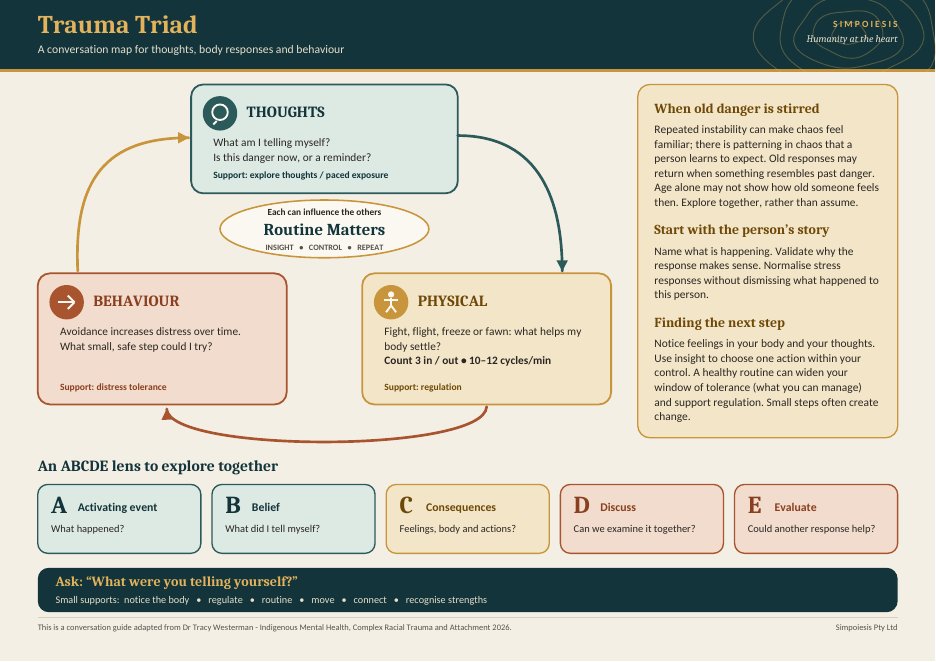
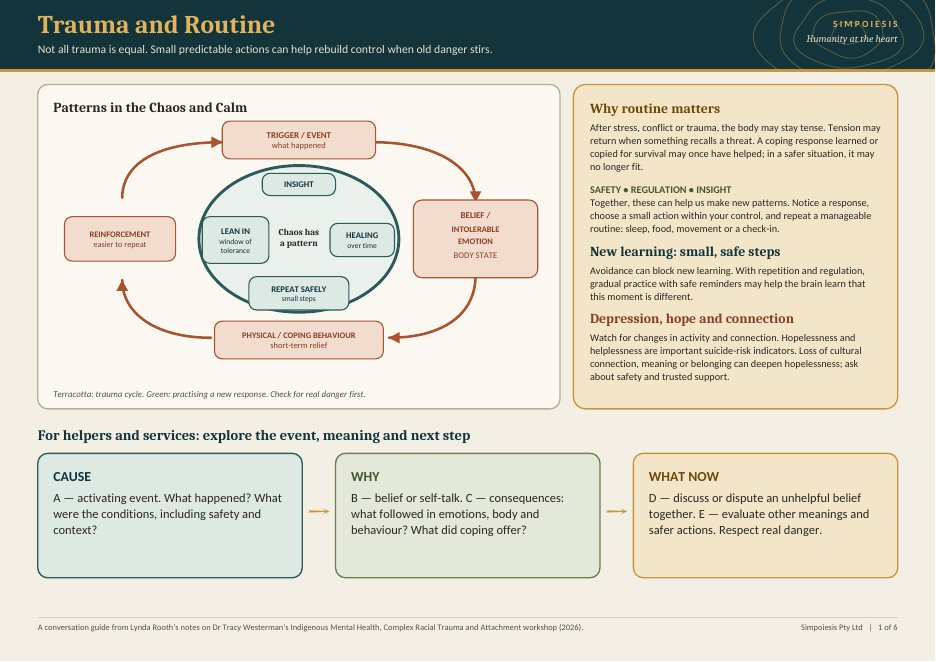
Trauma and Routine
A six-page guide to trauma, survival responses and small, safe steps. Download the PDF.
Conversation prompts for helpers, not a diagnostic or suicide-risk tool. Adapted from Dr Tracy Westerman’s Indigenous Mental Health, Complex Racial Trauma and Attachment workshop (2026).
Where In person or online.
Who Workers, teams and services.
How long A half-day workshop, a short series or a learning circle, shaped to fit.